Tell us about the job
Takes about a minute. No obligation.
Sizing a central AC system for a Jefferson County home is a local question, not a catalog one. 101 severe weather events were recorded in Jefferson County, Ohio between 2015 and 2024. That puts this county near the middle of the national distribution, which means severe weather is a real factor in how a contractor thinks about equipment selection and installation quality, but age of the home, duct condition, and sun exposure carry at least as much weight in the final numbers. A contractor quoting an install here accounts for the weather load without letting it crowd out the variables that actually vary house to house.
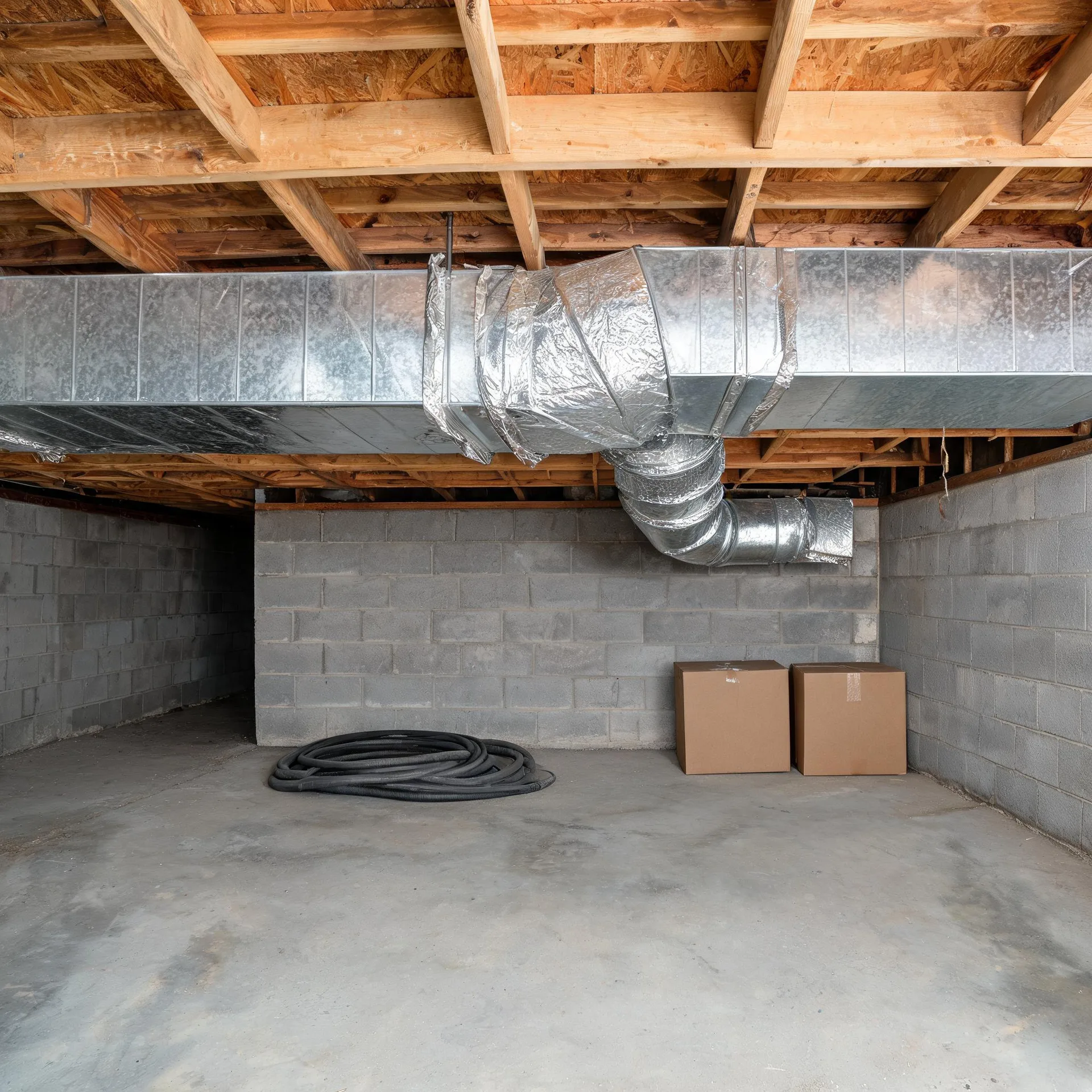
Ductwork laid into a house built for mid-century heating tends to follow the logic of that original system, with trunk sizes, branch runs, and return paths that a modern central AC unit will stress in ways the original design never anticipated. Half the homes in Jefferson County, Ohio were built in 1958 or earlier (2020-2024 ACS 5-year). A contractor installing new equipment here will open and measure what is already in the walls and crawlspaces before committing to a unit size, because undersized returns or restrictive branch runs limit what any new system can actually deliver, regardless of its rated capacity. The electrical service gets the same look, since panel capacity and circuit routing in stock of this age reflect the loads of a different generation of equipment.
What a Central AC Installation Covers, Part by Part
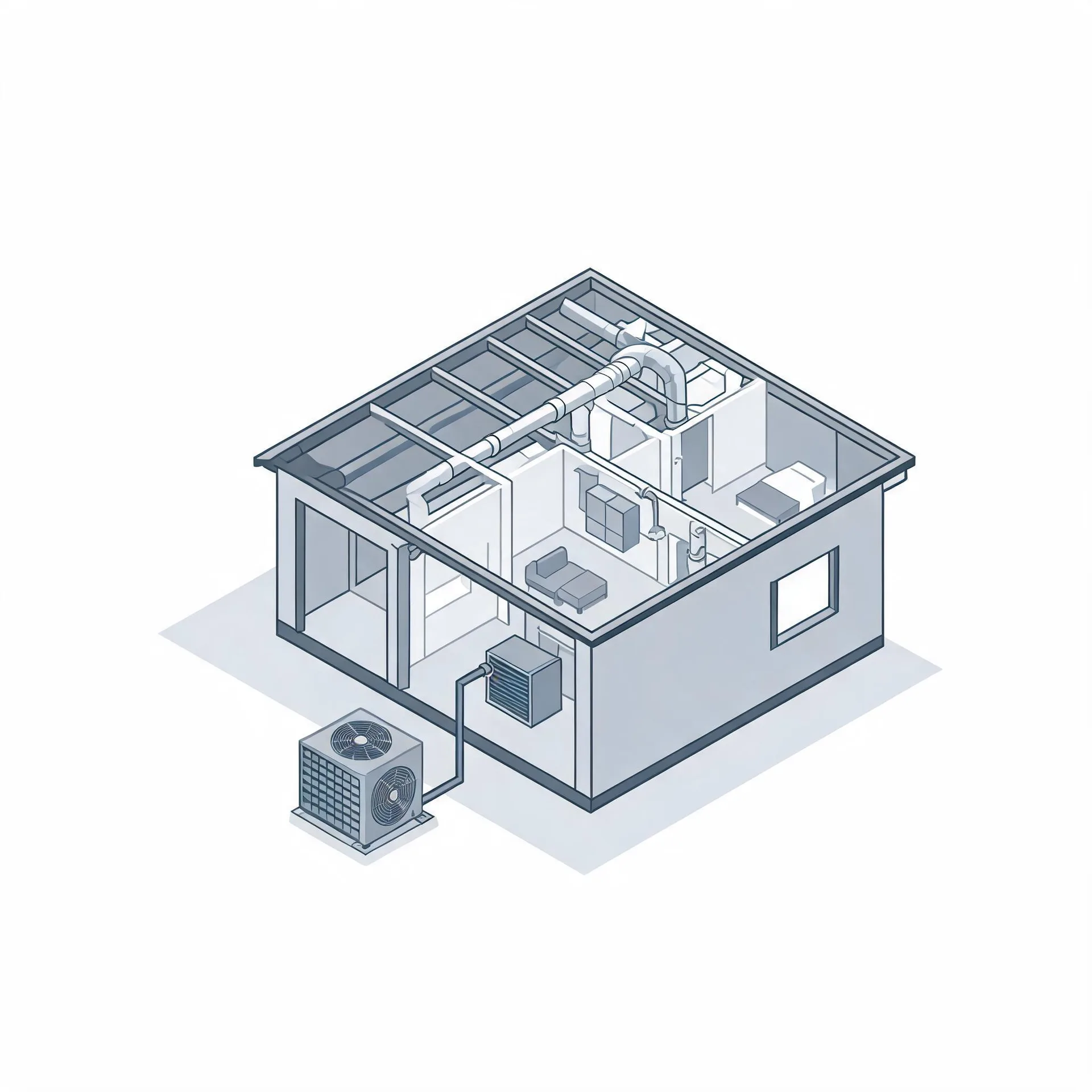
The outdoor unit sits on a concrete pad beside the house and holds the compressor and condenser coil, the two components that do the heaviest work in the system. Inside, the air handler or furnace cabinet mounts in a utility space, basement, or closet and contains the evaporator coil, which is where the refrigerant connection between the two units terminates.
A copper refrigerant line set runs between the outdoor unit and the indoor cabinet, and a condensate drain line carries moisture away from the evaporator coil to a floor drain or outside. A dedicated disconnect box mounts on the exterior wall near the outdoor unit, giving the contractor a local shutoff point for service.
The drawing shows a typical layout, and a licensed contractor determines exactly how each piece fits the configuration of your house.
Get matched in Jefferson CountyJefferson County, Ohio, by the numbers
101 severe weather events were recorded in Jefferson County, Ohio between 2015 and 2024.
NOAA National Centers for Environmental Information, Storm Events Database, bulk CSV export, events 2015-01-01 through 2024-12-31.Half the homes in Jefferson County, Ohio were built in 1958 or earlier (2020-2024 ACS 5-year).
U.S. Census Bureau, 2020-2024 American Community Survey 5-Year EstimatesJefferson County, Ohio holds 31,025 housing units (2020-2024 ACS 5-year).
U.S. Census Bureau, 2020-2024 American Community Survey 5-Year EstimatesOwners occupy 70.5% of the occupied homes in Jefferson County, Ohio (2020-2024 ACS 5-year).
U.S. Census Bureau, 2020-2024 American Community Survey 5-Year EstimatesRules & Standards Governing Central AC Installation in Jefferson County, Ohio22 sourced rules and standards
What the Installation Actually Looks Like
Split-system central air conditioners rated below 45,000 Btu/h manufactured on or after January 1, 2023 must meet a federal minimum of 13.4 SEER2.
Split-system central air conditioners rated at or above 45,000 Btu/h manufactured on or after January 1, 2023 must meet a federal minimum of 13.4 SEER2.
Split-system central air conditioners manufactured between January 1, 2015 and December 31, 2022 had to meet 13 SEER, the metric that preceded SEER2.
Single-package central air conditioners manufactured on or after January 1, 2023 must meet a federal minimum of 13.4 SEER2.
Space-constrained central air conditioners manufactured on or after January 1, 2023 must meet a federal minimum of 11.7 SEER2.
Federal efficiency standards for split-system central air conditioners and heat pumps are set on each certified combination of outdoor unit and indoor coil rather than on the outdoor unit alone.
Residential and light commercial air conditioning and heat pump systems assembled in the field, including mini-splits and unitary systems, may not be installed on or after January 1, 2025 using a refrigerant with a global warming potential above 700.
A field-assembled system whose specified components were all manufactured or imported before January 1, 2025 carries no installation compliance date under the refrigerant restrictions and may still be installed.
Licensing and Legal Requirements in Jefferson County, Ohio
An Ohio home construction services contract must include a copy of the supplier's certificate of insurance showing general liability coverage of not less than two hundred fifty thousand dollars.
In Ohio a home construction service means the construction of a residential building, including the repair, improvement, remodel or renovation of an existing structure, and does not include construction on a structure containing four or more dwelling units except for work on an individual dwelling unit within it.
A home construction service supplier in Ohio is defined as a person who contracts with an owner to provide home construction services for compensation and who maintains a general liability insurance policy of not less than two hundred fifty thousand dollars.
The Ohio construction industry licensing board issues state licenses to individuals as heating, ventilating and air conditioning contractors, refrigeration contractors, electrical contractors, plumbing contractors and hydronics contractors.
An Ohio board of county commissioners may accept a valid and unexpired Chapter 4740 license held by a heating, ventilating and air conditioning contractor toward its own licensing requirements for work on one-, two-, or three-family dwelling houses.
An Ohio board of county commissioners may adopt rules licensing heating, ventilating and air conditioning contractors who are not required to hold a state license under Chapter 4740.
In Ohio municipal law a specialty contractor includes heating, ventilating and air conditioning contractors, refrigeration contractors, electrical contractors, plumbing contractors and hydronics contractors.
An Ohio board of county commissioners may not register a specialty contractor who is required to hold a license under Chapter 4740 but does not hold a valid one.
An Ohio municipal corporation may not register a specialty contractor who is required to hold a license under Chapter 4740 but does not hold a valid one.
In Ohio building law a residential building means a one-family, two-family or three-family dwelling house and any accessory structure incidental to it, and does not include an industrialized unit, a manufactured home or a mobile home.
Ohio's contractor licensing chapter reaches only work on a construction project, and a construction project is defined to exclude residential buildings, so an HVAC contractor working on a one-, two-, or three-family dwelling in Ohio falls outside the state licensing requirement.
Violating Ohio's contractor licensing prohibition is a minor misdemeanor on a first violation and a misdemeanor of the fourth degree on subsequent violations.
Under Ohio law no person may act as or claim to be a type of contractor that Chapter 4740 licenses unless that person holds a license issued under that chapter.
In Ohio a home construction service supplier may not perform a home construction service costing twenty-five thousand dollars or more without entering into a written home construction services contract with the owner, unless the supplier and owner enter into a cost-plus contract.
Severe Weather Events in Jefferson County
Local weather puts real demands on cooling equipment, and those demands vary by where you live. A system sized and installed for Jefferson County's conditions handles the work that the climate here actually asks of it.
101 severe weather events, 2015–2024. Source: NOAA National Centers for Environmental Information, Storm Events Database.